

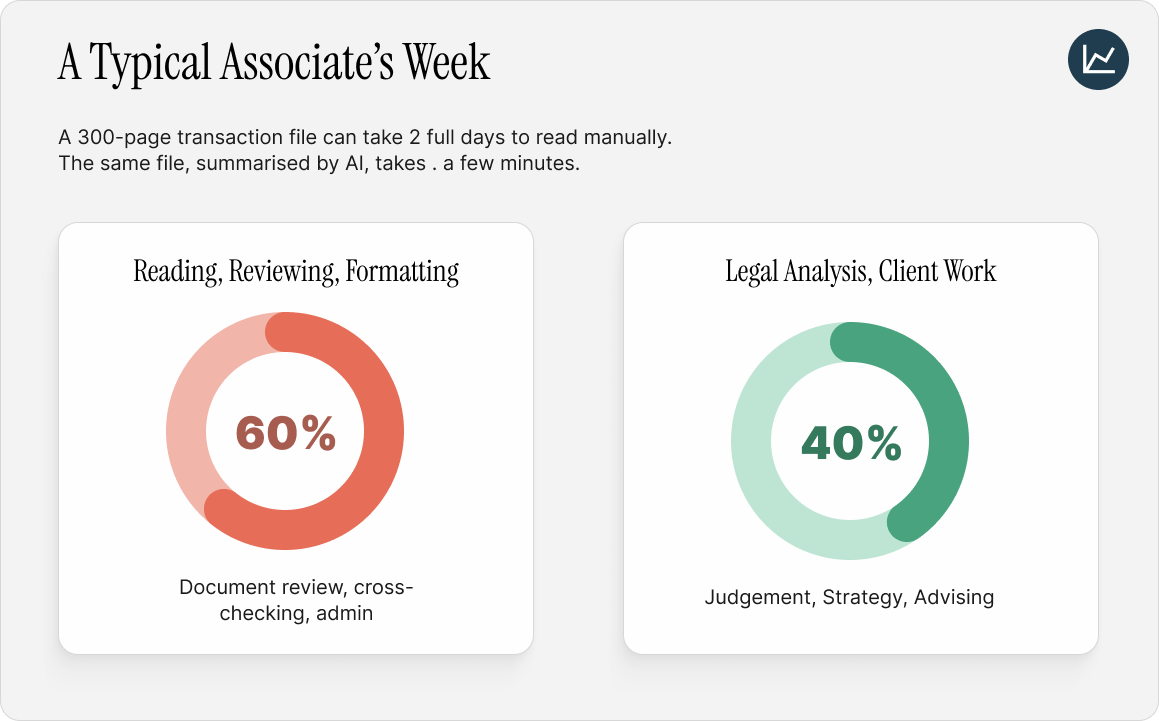
Here's a number that doesn't get talked about enough in UAE law firms. A big chunk of a junior associate's week — often more than half — goes into work that isn't actually legal thinking. It's reading. Searching. Copying clauses. Checking dates. Formatting.
That's not a criticism of associates. It's how the job has always worked. But it's worth looking at honestly, because it's expensive, and most firms have never measured it.
Where the hours actually go
Picture a typical week for a junior associate at a mid-size UAE firm. They're reviewing a 300-page property transaction file. Reading every page, flagging anything unusual, cross-checking dates against a different document, then writing a summary for the partner.
That single task can eat two full working days. Not because the associate is slow. Because reading is slow. Humans read at roughly the same speed whether the document is exciting or boring, simple or complex.
Why this matters more than it seems
It's easy to think “that's just how the job is.” But think about what those hours are actually costing the firm. A junior associate's billable time is valuable. Every hour spent reading and formatting is an hour not spent on the things that actually need a trained legal mind — spotting a risky clause, advising a client on strategy, preparing for a hearing. The reading itself doesn't need a law degree. It needs patience and time. The interpretation after the reading needs the law degree. When an associate spends 60% of their week on the first part, the firm is paying a lawyer's salary for work that doesn't require lawyer-level thinking.
What changes when AI does the reading
This is where AI tools, used properly, change the math. An AI can read a 300-page document and pull out the key clauses, flag anything unusual, and produce a clean summary in a few minutes. Not because it's smarter than the associate. Because reading at scale is exactly the kind of repetitive task computers are good at.
The associate still does the part that matters. They review the AI's summary, check it against their own judgment, and decide what actually goes to the partner or the client. The thinking stays human. The reading gets faster.
What this looks like for a real firm
Picture two firms of the same size, working the same caseload. One firm has associates spending most of their week on manual document review. The other firm has associates spending most of their week on actual case strategy and client interaction, because the document review now takes minutes instead of days.
Over a year, that difference adds up. The second firm can take on more matters without hiring more people. Or the same team handles the same workload with far less burnout. Either way, the firm is getting more value out of the same payroll.
What burnout actually costs a firm
There's a quieter cost here too, one that rarely shows up in a spreadsheet. Associates who spend most of their week on repetitive document review tend to burn out faster. They leave for other firms. They leave the profession altogether. Recruiting and training a replacement junior associate takes months, and during that gap, the rest of the team absorbs the extra workload.
Firms that free up associate time for higher value work tend to see better retention. The associate feels like they're actually being trained as a lawyer, not used as a human scanner. That's a real difference in how someone experiences their first few years in practice, and it shows up later in whether they stay.
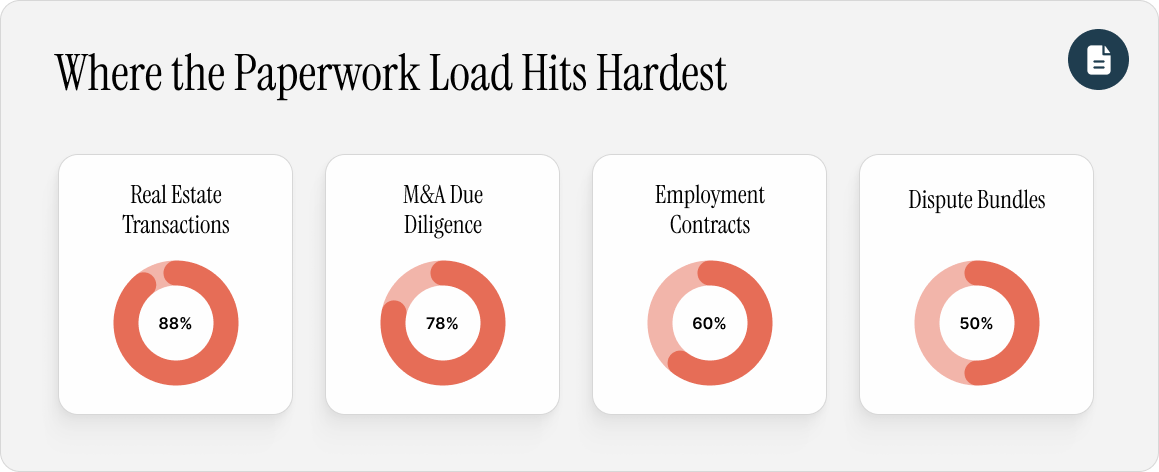
Practice areas with heavy paperwork feel this the most. Real estate transactions, M&A due diligence, employment contract reviews, and dispute bundles are all document-heavy by nature. A firm doing high volumes of any of these is sitting on the biggest opportunity to claw back associate hours, simply because the manual reading load is so large to begin with.
The honest point here
This isn't about replacing associates. It's about giving them their time back for the part of the job that actually needs a lawyer. The 60% spent on reading and formatting was never the valuable part of the job. It was just the unavoidable part — until now.
Firms that figure this out early aren't doing anything radical. They're just removing the slowest, least valuable part of the week and putting that time back into the work that builds client trust and grows the practice. The firms that wait are simply asking their best people to keep doing the part of the job that technology has already solved.