
Most UAE lawyers have seen it at least once. Two versions of the same contract. One in English, one in Arabic. Both signed. Both valid. Both saying something slightly different.
Nobody noticed during drafting. Nobody caught it in review. The deal closed. Then something went wrong, and suddenly both parties are looking at the same contract and reading two different obligations.
This is not a rare edge case. It happens regularly in UAE legal practice. And it matters more here than almost anywhere else in the world because the UAE is one of the few jurisdictions where both versions of a bilingual contract can carry equal legal weight.
Why the UAE is different:
In most countries, when a contract is translated, one language version controls. The other is just a reference. If there is a dispute, everyone looks at the controlling language and that is the end of it.
The UAE does not always work that way. Federal courts operate in Arabic. DIFC and ADGM courts operate in English. Many contracts in the UAE get drafted in both languages with a clause stating that both versions are equally authoritative. That means if the English version says one thing and the Arabic version says another, a court has to decide which one wins. And that decision can go either way.
This is the part that surprises lawyers who trained in the UK or US. A translation gap is not just a linguistic inconvenience. It is a potential dispute waiting to happen.
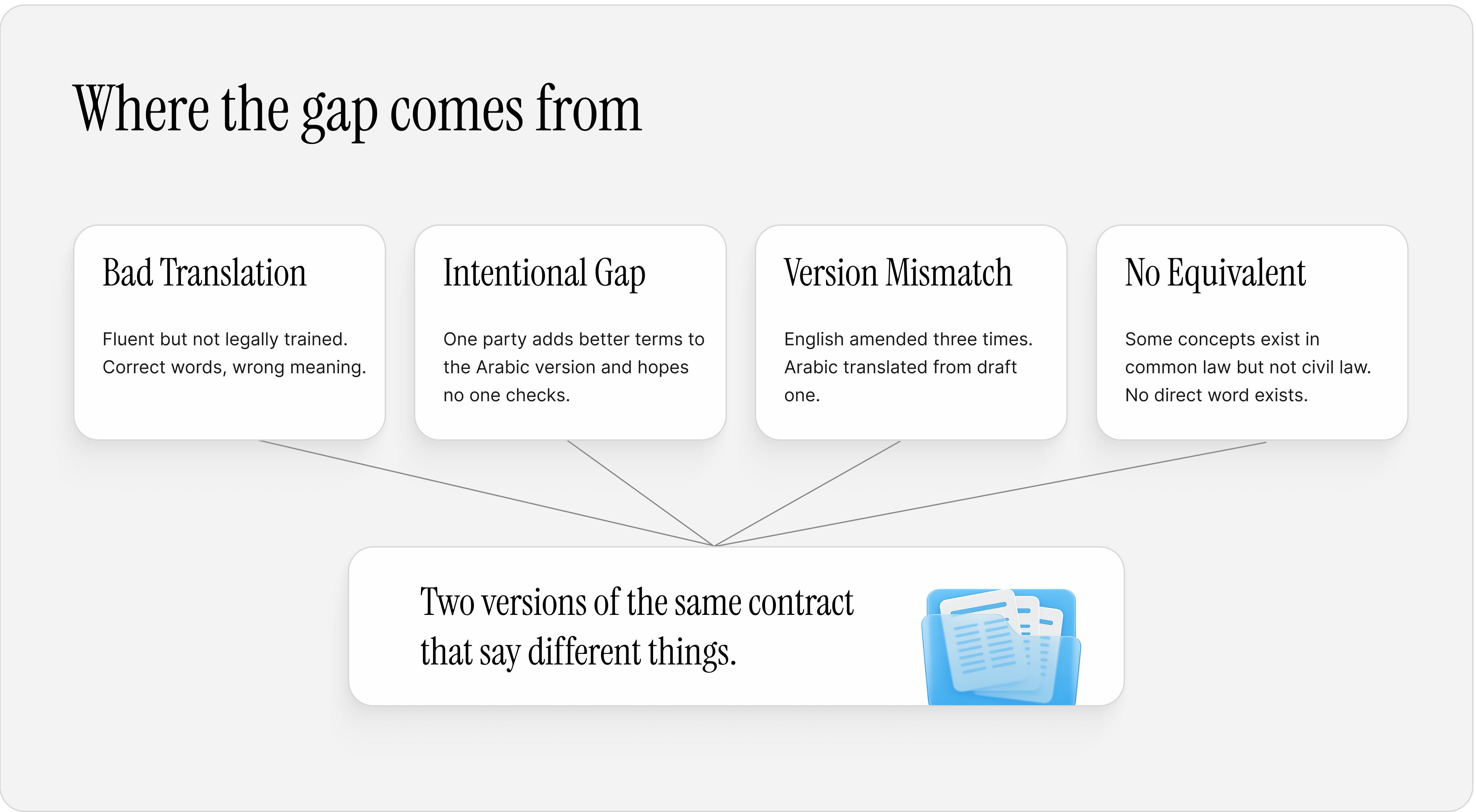
Where the gaps actually come from:
The obvious cause is bad translation. Someone who is fluent in both languages but not trained in legal drafting translates the contract. The words are technically correct. The legal meaning is not. Arabic and English do not map onto each other cleanly in a legal context. A single Arabic term can carry specific procedural meaning in a Federal Court context that has no direct English equivalent.
But bad translation is not the only cause. Sometimes the gap is intentional. One party drafts the Arabic version with slightly more favorable terms and hopes the other side reviews only the English. It sounds cynical. It happens.
Sometimes the gap comes from the drafting process itself. A contract gets negotiated in English, amended three times, then sent for Arabic translation at the end. The translator works from the first draft, not the final one. And sometimes the gap comes from legal concepts that simply do not exist in the same form across both systems.
What actually happens in a dispute:
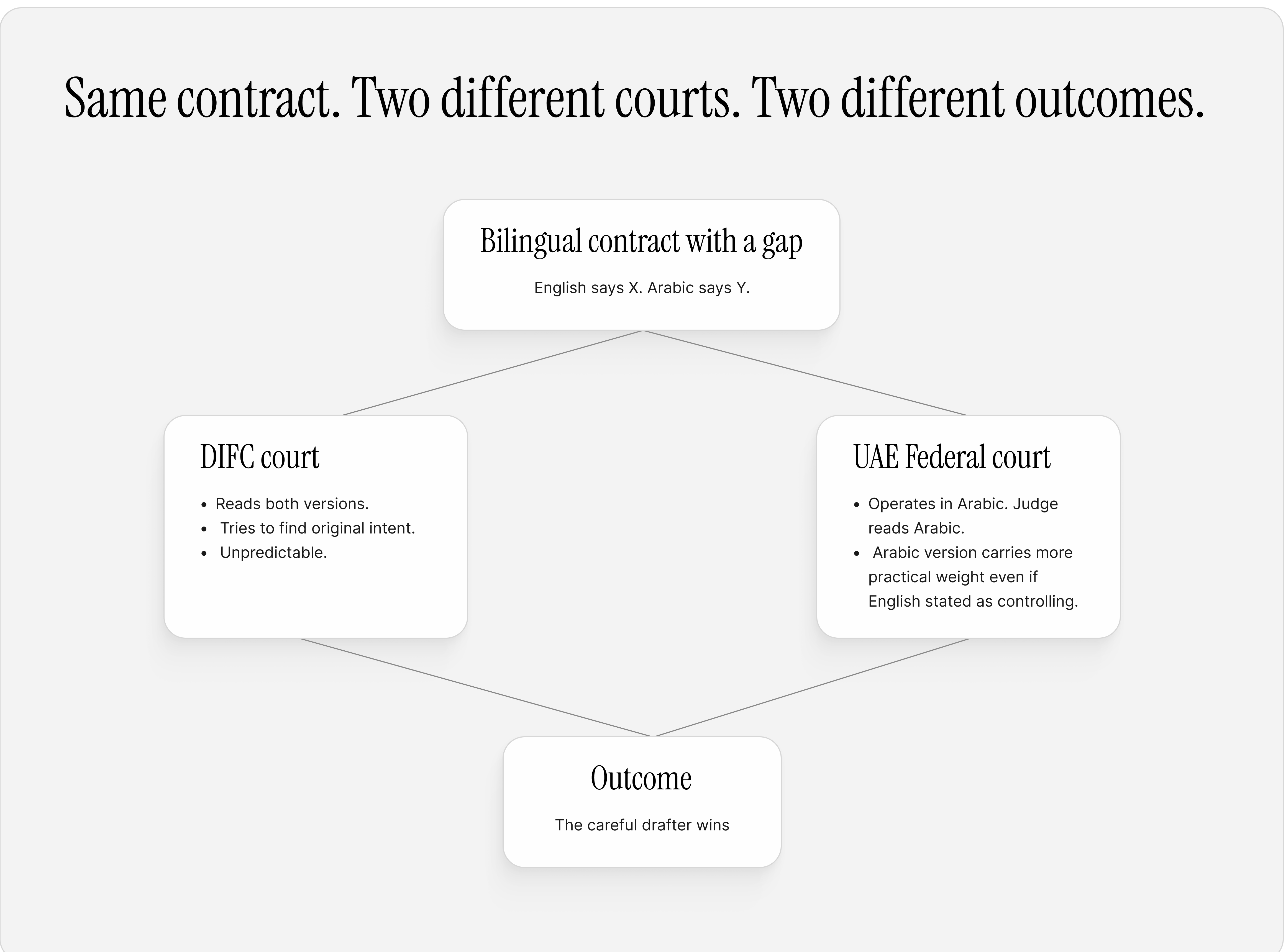
A DIFC court will look at both versions and try to determine the parties' original intent. If the contract says both versions are equally authoritative, the court reconciles the gap using principles of contract interpretation. That is a polite way of saying the outcome is unpredictable.
A Federal Court operates in Arabic, so the Arabic version tends to carry more practical weight in that forum even when the contract nominates English as controlling. The judge reads Arabic. The proceedings happen in Arabic. The Arabic version is right there.
Either way, the party that drafted more carefully wins. The party that assumed the translation was fine loses.
The practical problem for law firms:
Most firms review the English version carefully. The Arabic version gets translated after the commercial terms are agreed and reviewed much more quickly, if at all. Associates who are fluent in both languages are stretched across multiple matters. A deep bilingual review of every contract takes time that the deal timeline often does not allow.
The result is a systematic gap. English terms get scrutinized. Arabic terms get assumed correct. This is exactly the kind of problem that AI built specifically for UAE legal practice can catch. Not because the AI replaces the bilingual lawyer, but because it reads both versions simultaneously, flags where the language diverges, and surfaces those gaps before the contract closes rather than after a dispute starts.
A general AI tool trained on English legal text cannot do this. It reads the English version and produces a summary. It does not know the Arabic version exists, let alone what it says differently. The gap stays hidden.
What good bilingual review looks like:
You review both versions in parallel, not sequentially. You check every defined term in one language against its equivalent in the other. You pay specific attention to clauses about governing law, dispute resolution, termination, and liability. These are the clauses where translation gaps cause the most expensive problems.
You also check the hierarchy clause itself. The clause that says which language version controls needs to be identical in both versions. If the English version says English controls and the Arabic version says Arabic controls, you have a problem before you even get to the substance.
None of this is complicated. It is just thorough. And in a market where deals cross language lines on every transaction, thorough bilingual review is not optional. It is the job.